Hot articles
nioch.ru

Федеральное государственное бюджетное учреждение науки
Новосибирский институт органической химии им. Н.Н. Ворожцова
Это старая версия сайта! Новый сайт https://web3.nioch.nsc.ru/nioch/

В журнале International Journal of Molecular Sciences   (IF=6,208) опубликована статья  с участием сотрудников Института: д.х.н. Е.С. Стоянова (внс, ЛМР) и И.В. Стояновой (инженер ЛМР):

The Chloronium Cation [(C2H3)2Cl+] and Unsaturated C4-Carbocations with C=C and C≡C Bonds in Their Solid Salts and in Solutions: An H1/C13 NMR and Infrared Spectroscopic Study


Evgenii S. Stoyanov  and Irina V. Stoyanova

Int. J. Mol. Sci. 2022, 23(16), 9111;
Publication Date: Mayr 1, 2022


 https://doi.org/10.3390/ijms23169111

(This article belongs to the Special Issue Structure, Energy and Dynamics of Molecular Interactions)


Abstract

Solid salts of the divinyl chloronium (C2H3)2Cl+ cation (I) and unsaturated C4H6Cl+ and C4H7+ carbocations with the highly stable CHB11Hal11 anion (Hal=F, Cl) were obtained for the first time. At 120 °C, the salt of the chloronium cation decomposes, yielding a salt of the C4H5+ cation. This thermally stable (up to 200 °C) carbocation is methyl propargyl, CH≡C-C+-H-CH3 (VI), which, according to quantum chemical calculations, should be energetically much less favorable than other isomers of the C4H7+ cations. Cation VI readily attaches HCl to the formal triple C≡C bond to form the CHCl=CH-C+H-CH3 cation (VII). In infrared spectra of cations IVI, and VII, frequencies of C=C and C≡C stretches are significantly lower than those predicted by calculations (by 400–500 cm−1). Infrared and 1H/13C magic-angle spinning NMR spectra of solid salts of cations I and VI and high-resolution 1H/13C NMR spectra of VII in solution in SO2ClF were interpreted. On the basis of the spectroscopic data, the charge and electron density distribution in the cations are discussed. View Full-Text


Альметрики:


Метрики PlumX теперь доступны в Scopus: узнайте, как другие ученые используют ваши исследования


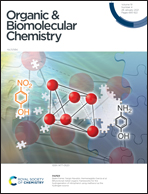
В журнале Organic & Biomolecular Chemistry (IF 3,89) опубликована статья с участием сотрудников Института  снс(к.х.н.) А.М. Генаева и снс Г.Е.  Сальникова


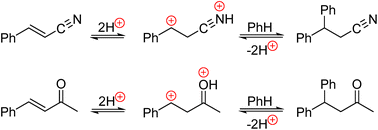
DFT insights into superelectrophilic activation of α,β-unsaturated nitriles and ketones in superacids

Alexander M. Genaev, George E. Salnikov and Konstantin Yu. Koltunov

Org. Biomol. Chem., 2022,20, 6799-6808,
first published on 06 Aug 2022


https://doi.org/10.1039/D2OB01141G


 C9DT043251

Abstract

Superelectrophilic activation of α,β-unsaturated carbonyl compounds and their isoelectronic analogs, proceeding normally under superacidic conditions, have led to a great variety of beneficial synthetic transformations. However, the essence of such activation is not yet fully recognized, while a number of alternative views on the subject have been discussed at length in the literature. Here, taking the example of virtual reactions of cinnamonitrile and benzalacetone with benzene, their feasible mechanistic variants, including multiple protonation (coordination to AlCl3) of the reactants, were analyzed based on density functional theory (DFT). It is revealed that the most plausible reaction pathways involve the initial N- or O-protonation (coordination to AlCl3) of the activated compounds followed by subsequent protonation on the α-C-atom. Dicationic superelectrophiles thus formed ensure practically barrier-free reactions with benzene in addition to a more favorable energetic profile of their generating, which is in marked contrast to other potential reaction pathways.

Альметрики:

Метрики PlumX теперь доступны в Scopus: узнайте, как другие ученые используют ваши исследования

В журнале  Spectrochimica Acta Part A: Molecular and Biomolecular Spectroscopy,   (IF 4.831) опубликована статья в соавторстве с сотрудниками Института:  к.х.н. Т.В. Вагановой (снс, ЛГетС), д.х.н. Е.В. Малыхина (гнс. ЛЭАСМ) и д.х.н. Ю.В. Гатилова (внс, ГРСА ЦСИ)

Synthetic approach for the control of self-doping in luminescent organic semiconductors

Enrico Benassi, Tamara Vaganova, Evgenij Malykhin, Yurij Gatilov, Lazzat Nurtay, Haiyan Fanc

Spectrochimica Acta Part A: Molecular and Biomolecular Spectroscopy
Volume 281, 15 November 2022, 121632
Available online 16 July 2022
doi: 10.1016/j.saa.2022.121632


Highlights

  • Mg doped CuCrO2 is a promising inorganic hole transport material for perovskite solar cells.
  • The analyzed device showed that 50 nm of both ETL and HTL thickness is quite sufficient to produce the highest efficiency.
  • Pb free, environmentally benign PSC performs outstanding efficiency 27.53% obtained through simulation.
  • The temperature gradient is almost constant (.0125) at higher temperature from 320K offer greater device stability.

Graphical abstract

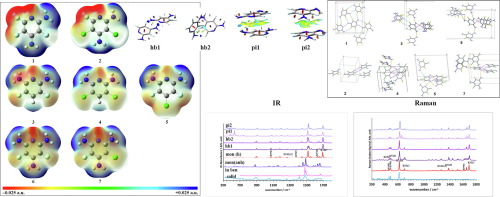
Six polyhalogenated di- or triamino pyridines were synthesised and structurally characterised by means of single crystal X-Ray diffraction. Their supramolecular synthons were studied by means of vibrational (FT-IR and Raman) spectroscopies and Quantum calculations. Features identified in spectra of the solid samples were distinctive of the formation of supramolecular (in particular, hydrogen bond) interactions. Quantitative correlations were established among the dimerisation energies, the ring structure and quantitative characteristics of spectra.


2022_07_18_VagMalGat_n


Abstract

Supramolecular synthon is identified as a unit and provides important structural and energetic information in the study of organic crystals. However, the direct estimation of the supramolecular interaction remains challenging. In the present work six polyhalogenated di– or triamino pyridines were synthesised, their crystalline structure was characterised, and corresponding supramolecular synthons were studied using a combination of quantum mechanical calculations and FT–IR and Raman spectroscopy. Some distinctive features were identified especially for three vibrational normal modes (RNMs) related to the pyridine ring (viz. RNM1, RNM3 and RNM7) in the vibrational spectra (FT–IR and Raman) of the solid samples, which are due to the supramolecular interactions, hydrogen bond (hb) in particular, according to the quantum mechanical calculations. The comparison between the IR and Raman spectra of experimental and simulated results indicates that the adjacent intermolecular hydrogen bonds between two same molecules extensively exist in the solid samples. Moreover, some quantitative correlation was established among the dimerisation energies for hb dimers (hb1 dimers for compounds 1 and 2), the ring structure defined by the distribution of the substituents and quantitative characteristics of the vibrational spectra, for instance, the splitting magnitudes for RNM3(2) in IR spectra and the peak gap between RNM1 and RNM2 in Raman spectra.

Альметрики: 


Метрики PlumX теперь доступны в Scopus: узнайте, как другие ученые используют ваши исследования


В журнале Pharmaceuticals (IF 5,215) опубликована статья с участием сотрудников Института: к.х.н. И.В. Ильиной (снс, ЛФАВ), д.х.н., проф РАН К.П. Волчо (гнс ЛФАВ) д.х.н. Ю.В. Гатилова (в.н.с. ГРСА, ЦСИ),  к.х.н. Д.К. Корчагиной  и чл.-корр. РАН, д.х.н., проф. Н.Ф. Салахутдинова (зав. отделом медицинской химии)

Biotransformation of (–)-Isopulegol by Rhodococcus rhodochrous

Irina B. Ivshina, Natalia A. Luchnikova, Polina Yu. Maltseva, Irina V. Ilyina, Konstantin P. Volcho, Yurii V. Gatilov, Dina V. Korchagina, Nadezhda A. Kostrikina, Vladimir V. Sorokin, Andrey L. Mulyukin and Nariman F. Salakhutdinov

 pharmaceuticals 15 00964 ag 550

Abstract

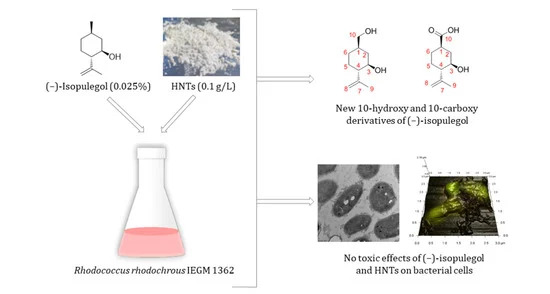
The ability of actinobacteria of the genus Rhodococcus to biotransform the monoterpenoid (–)-isopulegol has been established for the first time. Rrhodochrous strain IEGM 1362 was selected as a bacterium capable of metabolizing (–)-isopulegol to form new, previously unknown, 10-hydroxy (2) and 10-carboxy (3) derivatives, which may presumably have antitumor activity and act as respiratory stimulants and cancer prevention agents. In the experiments, optimal conditions were selected to provide the maximum target catalytic activity of rhodococci. Using up-to-date (TEM, AFM-CLSM, and EDX) and traditional (cell size, roughness, and zeta potential measurements) biophysical and microbiological methods, it was shown that (–)-isopulegol and halloysite nanotubes did not negatively affect the bacterial cells. The data obtained expand our knowledge of the biocatalytic potential of rhodococci and their possible involvement in the synthesis of pharmacologically active compounds from plant derivatives. View Full-Text

Keywords: biotransformationhalloysite nanotubes(–)-isopulegolmonoterpenoidRhodococcus rhodochrous

Альметрики: 

Метрики PlumX теперь доступны в Scopus: узнайте, как другие ученые используют ваши исследования

В журнале  Materials Chemistry Frontiers,   (IF 8.683) опубликована статья сотрудников Института:  д.х.н. А.Д. Куимова (мнс, ЛОЭ), к.х.н. К.С. Мельниковой-Беккер (снс. ЛОЭ), Н.А. Шумилова (мнс, ЛОЭ), И.Р. Коскина (мнс, ЛОЭ), к.х.н. А.А. Сониной (нс, ЛОЭ), к.х.н. И.К. Шундриной (снс, ЛЭАСМ, ГТ ЦСИ) и к.х.н. М.С. Казанцева (завлаб ЛОЭ)

Synthetic approach for the control of self-doping in luminescent organic semiconductors

Anatoly D. Kuimov, Christina S. Becker, Nikita A. Shumilov, Igor P. Koskin, Alina A. Sonina, Vladislav Yu. Komarov, Inna K. Shundrina and Maxim S. Kazantsev

Mater. Chem. Front., 2022,6(16), 2244-2255
first published on 05 Jul 2022

doi: 10.1039/D2QM00345G

2022_07_15_MChF


Abstract

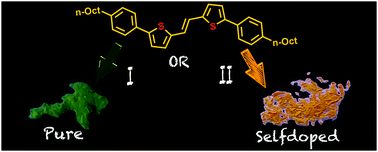
Molecular doping of organic luminescent materials is an efficient tool to tune their optoelectronic properties. In particular, self-doping by luminescent longer-conjugation chain chemical by-products is a convenient way to obtain highly emissive organic semiconductors. Although the self-doping approach allows us to avoid the necessity of dopant synthesis, to realize the self-doping and optimize dopant concentration there is a need for a stepwise gradual purification of a material which may be problematic. Here we report a synthetic approach allowing us to control self-doping in luminescent organic semiconductors based on arylene-vinylene co-oligomers. We designed 1,2-bis(5-(4-octylphenyl)thiophen-2-yl)ethene (C8-BPTE) and synthesized it via two pathways yielding batches with different self-dopant concentrations. Our approach does not require a complex purification and excludes a possible degradation of the materials under sublimation or chromatography conditions. The optical properties of C8-BPTE crystals have been demonstrated to be finely tuned by simple mixing of synthesized batches of the material in a desired proportion, the increase of self-doped material content showed an increase in PL QY by up to 1.7 times and caused a red shift of photoluminescence spectra. Moreover, C8-BPTE demonstrated good film-formation ability and the substrate-inclined crystallization showed an efficient way to control crystal lateral size and its orientation on the substrate. C8-BPTE thin-film also demonstrated good p-type charge transport in solution-processed organic field-effect transistors with mobility of up to 0.1 cm2 V−1 s−1.

Альметрики: 


Метрики PlumX теперь доступны в Scopus: узнайте, как другие ученые используют ваши исследования


Актуальные новости

13-01-2023

Категория: семинары НИОХ СО РАН

Семинар Отдела медицинской химии № 1, 25.01.2023 г. в 15-00 Доклад по диссертационной работе Решетникова Д. В.