В журнале Chemistry - A European Journal (IF=5,16) опубликована статья с участием сотрудника Института к.х.н. А.М. Агафонцева (с.н.с, ЛТС)
Ratiometric detection of ATP by fluorescent cyclophanes with bellows‐type sensing mechanism
Aleksandr M. Agafontsev, Tatiana A. Shumilova, Aleksandr S. Oshchepkov, Frank Hampel, Evgeny A Kataev
Chemistry - A European Journal,
Volume 26 , Issue 44 Special Issue: Young Chemists 2020
August 6, 2020, Pages 9991-9997
 This article also appears in:
https://doi.org/10.1002/chem.202001523
Abstract
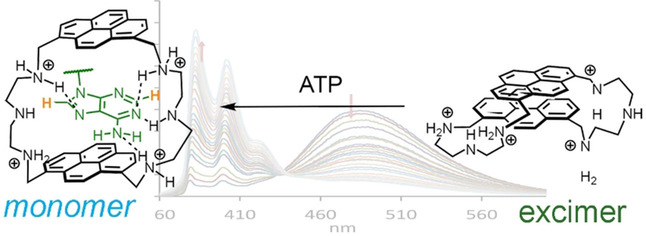
Pyrene‐based cyclophanes have been synthesized with the aim to realize a bellows‐type sensing mechanism for the ratiometric detection of nucleotide concentrations in a buffered aqueous solution. The sensing mechanism involves the encapsulation of a nucleobase between two pyrene rings, which affects the monomer‐excimer equilibrium of the receptor in the excited state. The nature of the spacer and its connection pattern to pyrene rings have been varied to achieve high selectivity for ATP. The 1,8‐substituted pyrene‐based cyclophane with the 2,2′‐diaminodiethylamine spacer demonstrates the best selectivity for ATP showing a 50‐fold increase in the monomer‐excimer emission ratio upon saturation with the nucleotide. The receptor can detect ATP within the biological concentrations range over a wide pH range. NMR and spectroscopic studies have revealed the importance of hydrogen bonding and stacking interactions for achieving a required receptor selectivity. The probe has been successfully applied for the real‐time monitoring of creatine kinase activity.
Альметрики:


![[double bond, length as m-dash]](https://www.rsc.org/images/entities/char_e001.gif) O⋯M2+contacts and N–H⋯Cl hydrogen bonds with coordinated Cl− ions. In solutions the complexes have several conformers differing by the degree of the turn of the acetamide moiety relative to the ligand core and the type of its interaction with the coordination core. The ligands and complexes exhibit luminescence with the quantum yield increasing in the order: ligand < cadmium(II) complex < zinc(II) complex. The complexes 3 and 4 demostrate excitation wavelength independent single-channel fluorescence. As opposed to 3 and 4, the complexes 1 and 2 demonstrate excitation wavelength dependent emission with nanosecond and microsecond lifetimes of the excited states. According to our TD-DFT calculations, an interplay of ligand centered and halide to ligand transitions facilitates two deactivation channels in 1 and 2: S1–S0 and T1–S0.
O⋯M2+contacts and N–H⋯Cl hydrogen bonds with coordinated Cl− ions. In solutions the complexes have several conformers differing by the degree of the turn of the acetamide moiety relative to the ligand core and the type of its interaction with the coordination core. The ligands and complexes exhibit luminescence with the quantum yield increasing in the order: ligand < cadmium(II) complex < zinc(II) complex. The complexes 3 and 4 demostrate excitation wavelength independent single-channel fluorescence. As opposed to 3 and 4, the complexes 1 and 2 demonstrate excitation wavelength dependent emission with nanosecond and microsecond lifetimes of the excited states. According to our TD-DFT calculations, an interplay of ligand centered and halide to ligand transitions facilitates two deactivation channels in 1 and 2: S1–S0 and T1–S0.