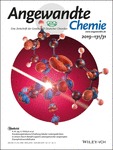
В журнале Angewandte Chemie Int. Ed. (IF=12.959) опубликована статья с участием сотрудников Института: д.х.н. Е. В. Третьякова(завлаб ЛИНИРР), к.х.н. С. И. Живетьевой (снс, ЛИНИРР), д.х.н. И. Ю. Багрянской (внс, рук. ГРСА), к.х.н. М.С. Казанцева (завлаб, ЛОЭ), к.х.н. И.К. Шундриной (снс, ЛЭАСМ), к.х.н. Е.В. Зайцевой (нс, ЛМР), к.ф.-м.н. Д.А. Пархоменко (нс, ЛМР) и д.ф.-м.н., проф. Е.Г. Багрянской
Ferromagnetically Coupled S = 1 Chains in Crystals of Verdazyl‐Nitronyl Nitroxide Diradicals
Angewandte Chemie International Edition
Volume 59, Issue 46, November 9, 2020, Pages 20704-20710
Publication Date:July 27, 2020
https://doi.org/10.1002/anie.202010041
Abstract
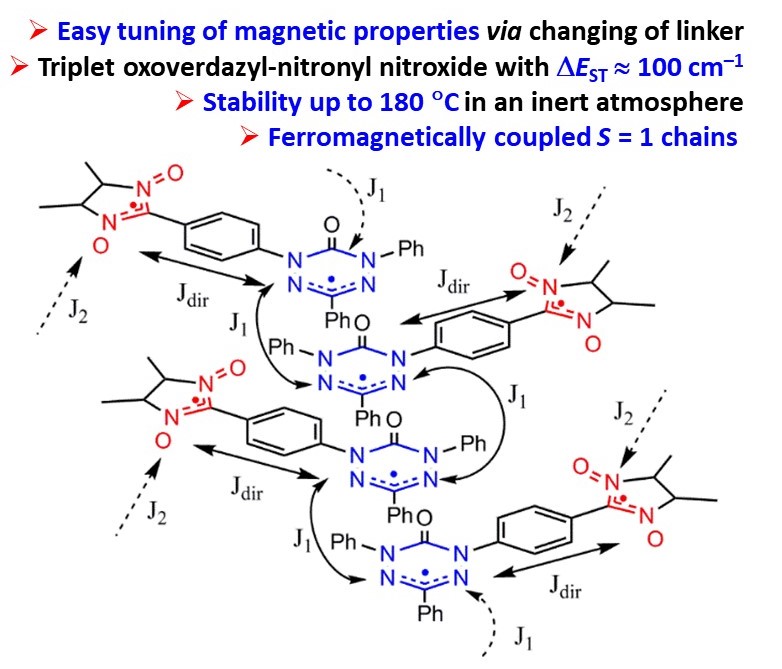
Thermally stable organic diradicals with a triplet ground state along with large singlet‐triplet energy gap have significant potential for advanced technological applications. A series of phenylene‐bridged diradicals with oxoverdazyl and nitronyl nitroxide units were synthesized via a palladium‐catalyzed cross‐coupling reaction of the corresponding iodoverdazyls with a nitronyl nitroxide‐2‐ide gold(I) complex with high yields (up to 82%). The synthesized diradicals exhibit high stability and do not decompose in an inert atmosphere up to 180 °C. The magnetic properties of prepared phenylene‐coupled diradicals were investigated and magneto‐structural correlations were established. For the studied diradicals, both substantial antiferromagnetic (D E ST » ‐64 cm –1 ) and ferromagnetic (D E ST ³ 25 and 100 cm –1 ) intramolecular exchange interactions were observed. The sign of the exchange interaction is determined both by the bridging moiety ( para ‐ or meta ‐phenylene) and by the type of oxoverdazyl block ( C ‐linked or N ‐linked). Upon crystallization, diradicals with the triplet ground state form unique one‐dimensional exchange‐coupled chains with strong intra‐ and weak inter‐diradical ferromagnetic coupling.
Альметрики:





 This article also appears in:


![[double bond, length as m-dash]](https://www.rsc.org/images/entities/char_e001.gif) O⋯M2+contacts and N–H⋯Cl hydrogen bonds with coordinated Cl− ions. In solutions the complexes have several conformers differing by the degree of the turn of the acetamide moiety relative to the ligand core and the type of its interaction with the coordination core. The ligands and complexes exhibit luminescence with the quantum yield increasing in the order: ligand < cadmium(II) complex < zinc(II) complex. The complexes 3 and 4 demostrate excitation wavelength independent single-channel fluorescence. As opposed to 3 and 4, the complexes 1 and 2 demonstrate excitation wavelength dependent emission with nanosecond and microsecond lifetimes of the excited states. According to our TD-DFT calculations, an interplay of ligand centered and halide to ligand transitions facilitates two deactivation channels in 1 and 2: S1–S0 and T1–S0.
O⋯M2+contacts and N–H⋯Cl hydrogen bonds with coordinated Cl− ions. In solutions the complexes have several conformers differing by the degree of the turn of the acetamide moiety relative to the ligand core and the type of its interaction with the coordination core. The ligands and complexes exhibit luminescence with the quantum yield increasing in the order: ligand < cadmium(II) complex < zinc(II) complex. The complexes 3 and 4 demostrate excitation wavelength independent single-channel fluorescence. As opposed to 3 and 4, the complexes 1 and 2 demonstrate excitation wavelength dependent emission with nanosecond and microsecond lifetimes of the excited states. According to our TD-DFT calculations, an interplay of ligand centered and halide to ligand transitions facilitates two deactivation channels in 1 and 2: S1–S0 and T1–S0.