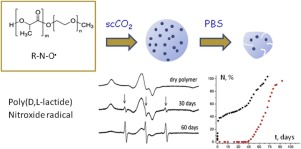
В журналу Materials Science and Engineering: C (IF 4,959) опубликована статья с участием сотрудников Института: д.м.н. Н.А. Жуковой (внс, ЛФИ), д.б.н. М.В. Хвостова (снс, ЛФИ), к.б.н.А.В. Павловой (нс, ЛФИ) и д.б.н., проф. Т.Г. Толстиковой (завлаб, ЛФИ)
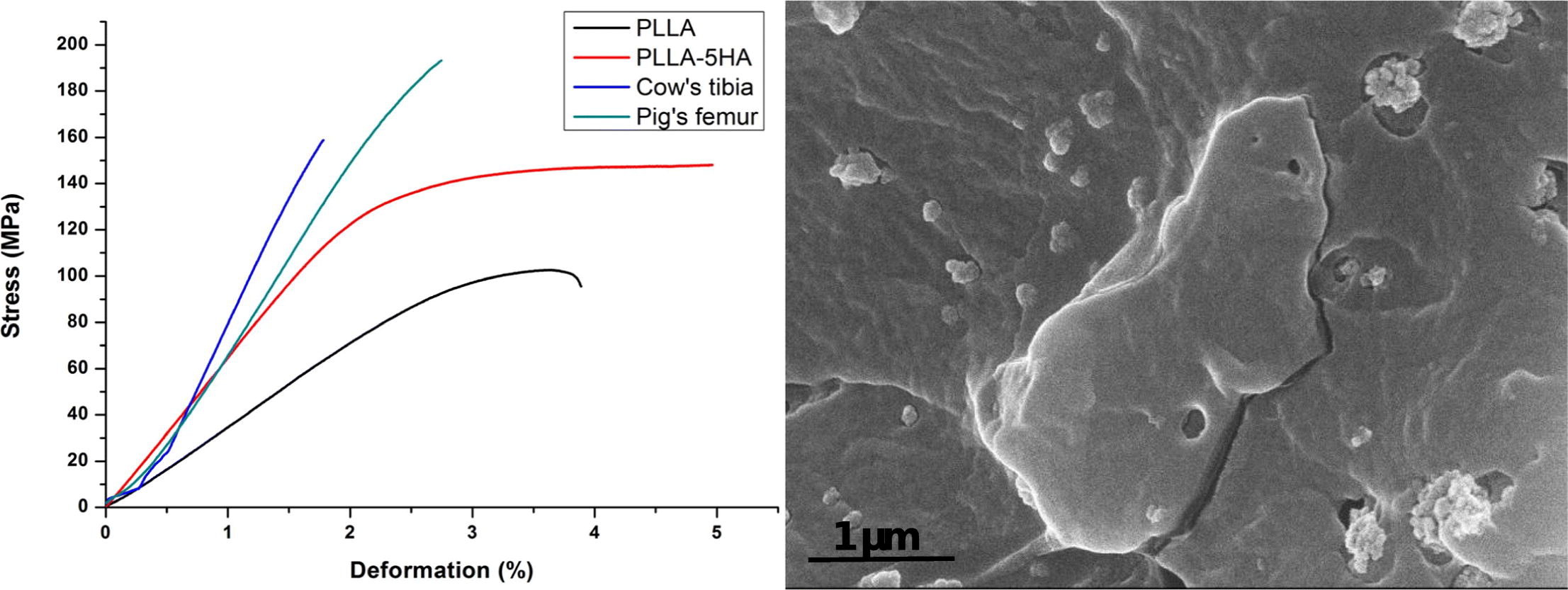
Biodegradable poly(l-lactide)/calcium phosphate composites with improved properties for orthopedics: Effect of filler and polymer crystallinity
Varvara A.Demina, Sergei V. Krasheninnikov, Alexander I. Buzin, Roman A. Kamyshinsky, Natalya V. Sadovskaya, Evgeny N. Goncharov, Natalya A. Zhukova, Mikhail V. Khvostov, Alla V. Pavlova, Tatjana G. Tolstikova, Nikita G. Sedush, Sergei N. ChvalunMaterials Science and Engineering: C Volume 112, July 2020, 110813 ,
Publication Date:March 06, 2020
https://doi.org/10.1016/j.msec.2020.110813
Abstract
Biodegradable poly(l-lactide)/calcium phosphate composites are promising materials for fabrication of bone fixation implants with improved properties. Multistage compounding was proposed as an efficient method for the preparation of biodegradable poly(l-lactide)/calcium phosphate composites with submicron filler dispersion and mechanical characteristics similar to native bone. The improvement of the characteristics is caused both by the filler itself and by the increase of polymer crystallinity due to the nucleation effect. The technique allows to fabricate biodegradable composites with controlled properties by varying concentration and type of the filler as well as degree of PLLA matrix crystallinity. Animal studies revealed that all the composites were biocompatible and non-toxic.
Альметрики:






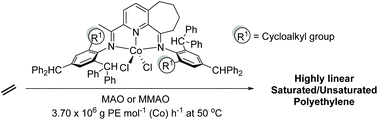
![[double bond, length as m-dash]](https://www.rsc.org/images/entities/char_e001.gif) CMe}-9-{N(Ar)}C10H10N]CoCl2 (Ar = 2-(C5H9) -4,6-(CHPh2)2C6H2 Co1, 2-(C6H11)-4,6-(CHPh2)2C6H2 Co2, 2-(C8H15)-4,6-(CHPh2) 2C6H2 Co3, 2-(C12H23)-4,6-(CHPh2 )2C6H2 Co4, 2,6-(C5H9)2 -4-(CHPh2)C6H2 Co5). All five complexes have been characterized by a combination of FT-IR spectroscopy, elemental analysis and single crystal X-ray diffraction. The molecular structures of Co1, Co3 and Co5 highlight the substantial steric hindrance imparted by the 2-cycloalkyl-6-benzhydryl or 2,6-dicyclopentyl ortho-substitution pattern; distorted square pyramidal geometries are exhibited in each case. On activation with methylaluminoxane (MAO) or modified methylaluminoxane (MMAO), all the complexes (apart from Co4/MAO) were active ethylene polymerization catalysts (up to 3.70 ? 106 g PE per mol (Co) per h for Co5/MMAO), operating effectively at temperatures between 50 °C and 60 °C, producing polyethylenes with high molecular weights (up to 589.5 kg mol-1 for Co3/MAO). Furthermore, all polymers were highly linear (Tm > 130 °C) with narrow dispersities (Mw/Mn range: 2.0–3.0). The coexistence of two chain termination pathways, β-H elimination and transfer to aluminum, has been demonstrated using 13 C/1H NMR spectroscopy.
CMe}-9-{N(Ar)}C10H10N]CoCl2 (Ar = 2-(C5H9) -4,6-(CHPh2)2C6H2 Co1, 2-(C6H11)-4,6-(CHPh2)2C6H2 Co2, 2-(C8H15)-4,6-(CHPh2) 2C6H2 Co3, 2-(C12H23)-4,6-(CHPh2 )2C6H2 Co4, 2,6-(C5H9)2 -4-(CHPh2)C6H2 Co5). All five complexes have been characterized by a combination of FT-IR spectroscopy, elemental analysis and single crystal X-ray diffraction. The molecular structures of Co1, Co3 and Co5 highlight the substantial steric hindrance imparted by the 2-cycloalkyl-6-benzhydryl or 2,6-dicyclopentyl ortho-substitution pattern; distorted square pyramidal geometries are exhibited in each case. On activation with methylaluminoxane (MAO) or modified methylaluminoxane (MMAO), all the complexes (apart from Co4/MAO) were active ethylene polymerization catalysts (up to 3.70 ? 106 g PE per mol (Co) per h for Co5/MMAO), operating effectively at temperatures between 50 °C and 60 °C, producing polyethylenes with high molecular weights (up to 589.5 kg mol-1 for Co3/MAO). Furthermore, all polymers were highly linear (Tm > 130 °C) with narrow dispersities (Mw/Mn range: 2.0–3.0). The coexistence of two chain termination pathways, β-H elimination and transfer to aluminum, has been demonstrated using 13 C/1H NMR spectroscopy.