В журнале The Journal of Physical Chemistry Letters (IF=6,71) опубликована статья с участием сотрудников Института к.х.н. О.И. Рогожниковой (с.н.с, ГИТР), Д.В. Трухина (снс, ГИТР), к.х.н. А.А. Кужелева (нс, ЛОЭ), д.ф.-м.н., проф. Е.Г. Багрянской (Директор НИОХ), к.х.н. В.М. Тормышева (снс, рук. группы ГИТР)
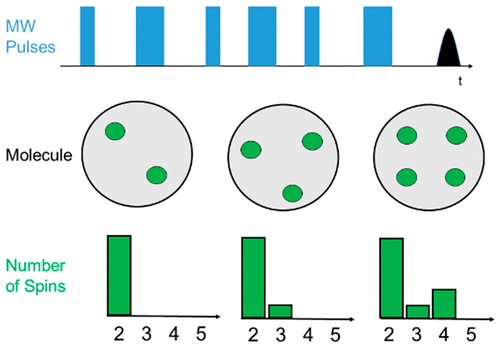
Multiquantum Counting of Trityl Radicals
Matthias Bretschneider, Phillip E. Spindler, Olga Yu. Rogozhnikova, Dmitry V. Trukhin, Burkhard Endeward, Andrey A. Kuzhelev, Elena Bagryanskaya, Victor M. Tormyshev, and Thomas F. PrisnerJ. Phys. Chem. Lett. 2020, 11, 15, 6286–6290
Publication Date:July 15, 2020
https://doi.org/10.1021/acs.jpclett.0c01615
Abstract
We demonstrate a series of multitrityl radical compounds where accurate spin-counting by pulsed electron paramagnetic resonance (EPR) can be achieved at X-band (9 GHz) frequencies, even for molecules with very short and flexible linkers. Multiquantum filter experiments, well-known from NMR, were used to count the number of coupled electron spins in these compounds. The six pulse double quantum filter sequence used in EPR for distance determinations in biradicals was used. Precise phase settings to separate higher quantum coherences were achieved by an arbitrary waveform generator. The trityl radicals have narrow spectral width so that homogeneous excitation of all spins by the pulses is possible. The transversal relaxation times of higher quantum coherences of trityl radicals are sufficiently long to allow their detection. Our results on model compounds show the potential of this approach to determine oligomeric states in protein complexes in their native environment using functionalized trityl spin labels.
Альметрики:




 This article also appears in:


![[double bond, length as m-dash]](https://www.rsc.org/images/entities/char_e001.gif) O⋯M2+contacts and N–H⋯Cl hydrogen bonds with coordinated Cl− ions. In solutions the complexes have several conformers differing by the degree of the turn of the acetamide moiety relative to the ligand core and the type of its interaction with the coordination core. The ligands and complexes exhibit luminescence with the quantum yield increasing in the order: ligand < cadmium(II) complex < zinc(II) complex. The complexes 3 and 4 demostrate excitation wavelength independent single-channel fluorescence. As opposed to 3 and 4, the complexes 1 and 2 demonstrate excitation wavelength dependent emission with nanosecond and microsecond lifetimes of the excited states. According to our TD-DFT calculations, an interplay of ligand centered and halide to ligand transitions facilitates two deactivation channels in 1 and 2: S1–S0 and T1–S0.
O⋯M2+contacts and N–H⋯Cl hydrogen bonds with coordinated Cl− ions. In solutions the complexes have several conformers differing by the degree of the turn of the acetamide moiety relative to the ligand core and the type of its interaction with the coordination core. The ligands and complexes exhibit luminescence with the quantum yield increasing in the order: ligand < cadmium(II) complex < zinc(II) complex. The complexes 3 and 4 demostrate excitation wavelength independent single-channel fluorescence. As opposed to 3 and 4, the complexes 1 and 2 demonstrate excitation wavelength dependent emission with nanosecond and microsecond lifetimes of the excited states. According to our TD-DFT calculations, an interplay of ligand centered and halide to ligand transitions facilitates two deactivation channels in 1 and 2: S1–S0 and T1–S0.